Homelab
A small production environment I am allowed to break
It is where I test infrastructure ideas, security tooling and automation before I trust them anywhere that matters. It also keeps my data in my own hands. This page describes the concepts only, never addresses or configuration.
Concept view
Zones, not addresses
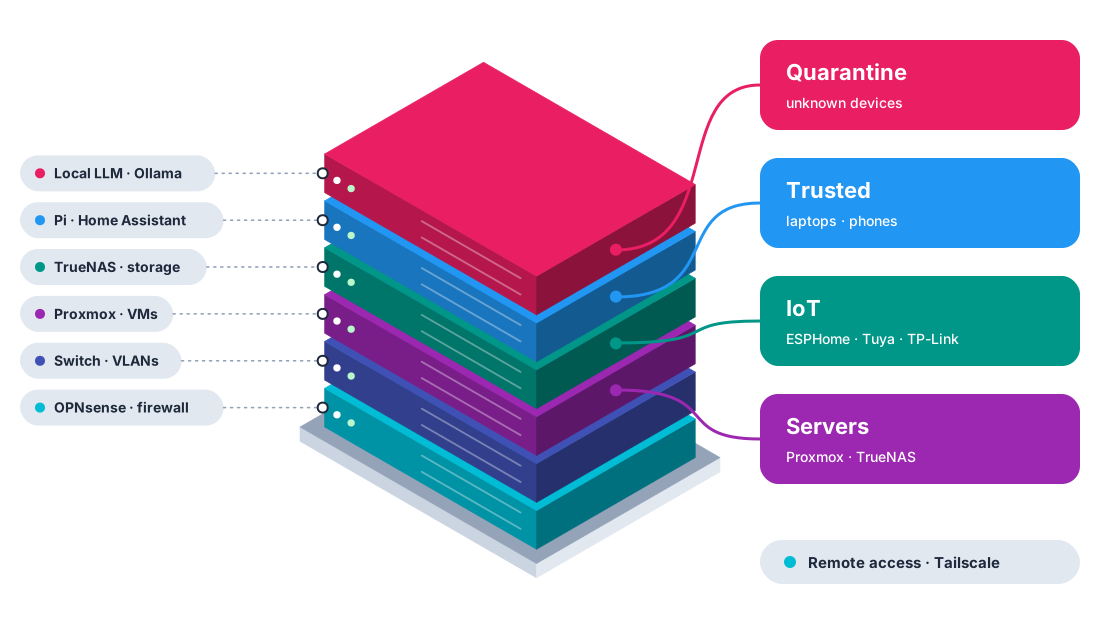
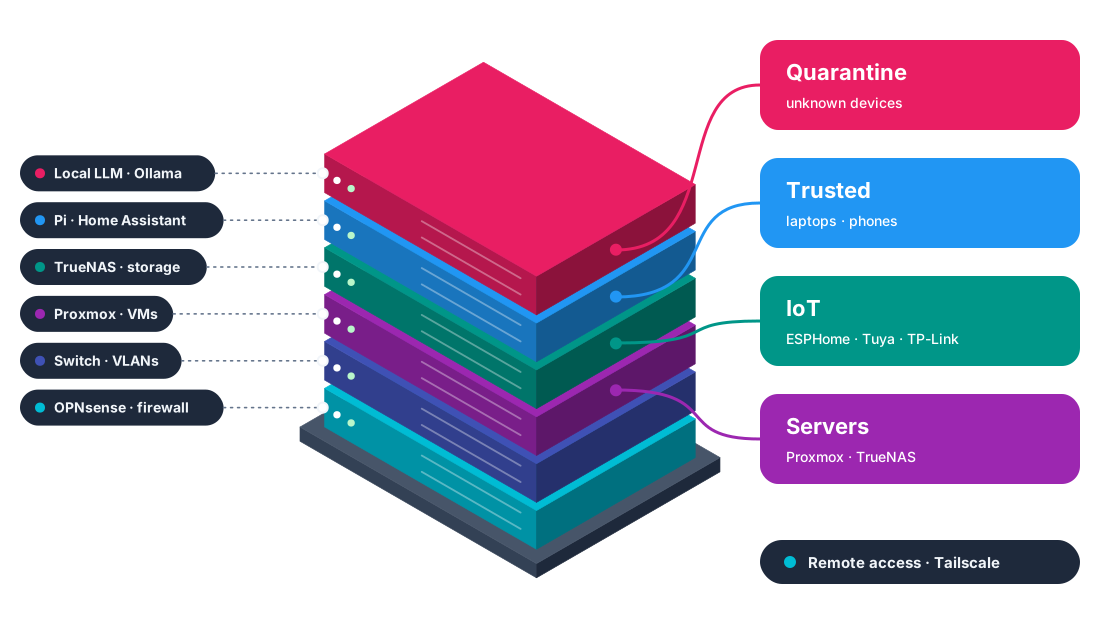
Trusted, server, IoT and quarantine zones sit behind a firewall, with storage, virtualisation and home automation each in their place. Shown here at concept level only.
What it covers
Compute, storage, network, services
Compute and virtualisation
A Proxmox host running virtual machines and containers, and a mix of Raspberry Pi and Orange Pi boards for dedicated low-power services. A dedicated local LLM host (Ollama, Ryzen-class CPU, 32 GB RAM) serves small models as an additional provider to multi-model apps.
Storage and backup
A TrueNAS server is the central store. Snapshot-style backups use rsync with hardlinks to NFS, chosen deliberately for simplicity over heavier tooling.
Network and security
A segmented network (trusted, servers, IoT and quarantine zones) built around OPNsense. Intrusion detection and SIEM-style visibility with Suricata, Wazuh, CrowdSec and Grafana. OpenWrt on multiple access points, with an ongoing Wi-Fi overhaul adding Wi-Fi 6 coverage and isolating IoT and guest devices on firewalled VLANs. Tailscale is the secure remote-access and recovery path.
Self-hosted services
Personal cloud storage and file sync, a password vault, a wiki, a smart-home hub and file transfer services, all running in containers across the Pis and NAS.
Smart home and automation
Home Assistant on a Raspberry Pi 5. ESPHome devices, plus Tuya and TP-Link ecosystems brought under local control. Custom integrations, including a reverse-engineered utility portal integration for energy data, and animated weather-aware dashboard themes built from layered SVG.
Real-world troubleshooting
Diagnosing and fixing real network and storage problems, such as tracing a recurring hang back to the storage I/O layer rather than the NIC.
Travel and connectivity
Projects that leave the house
GigaTravel
A pocket travel router on an Orange Pi Zero 3, with a captive-portal login workflow for hotel networks and an out-of-band recovery path.
In-flight media server
A concept using yt-dlp and podcast tooling on a spare board.
Home telephony
Home telephony on a fibre ONT with a SIP voice profile.
Principles
Four rules I follow
- Segment everything. IoT does not belong next to your laptop.
- Backups you can restore beat backups you can brag about.
- Local first, cloud when it earns it.
- Write it down. Every fix goes into a doc, ideally one that ends up on GitHub.